
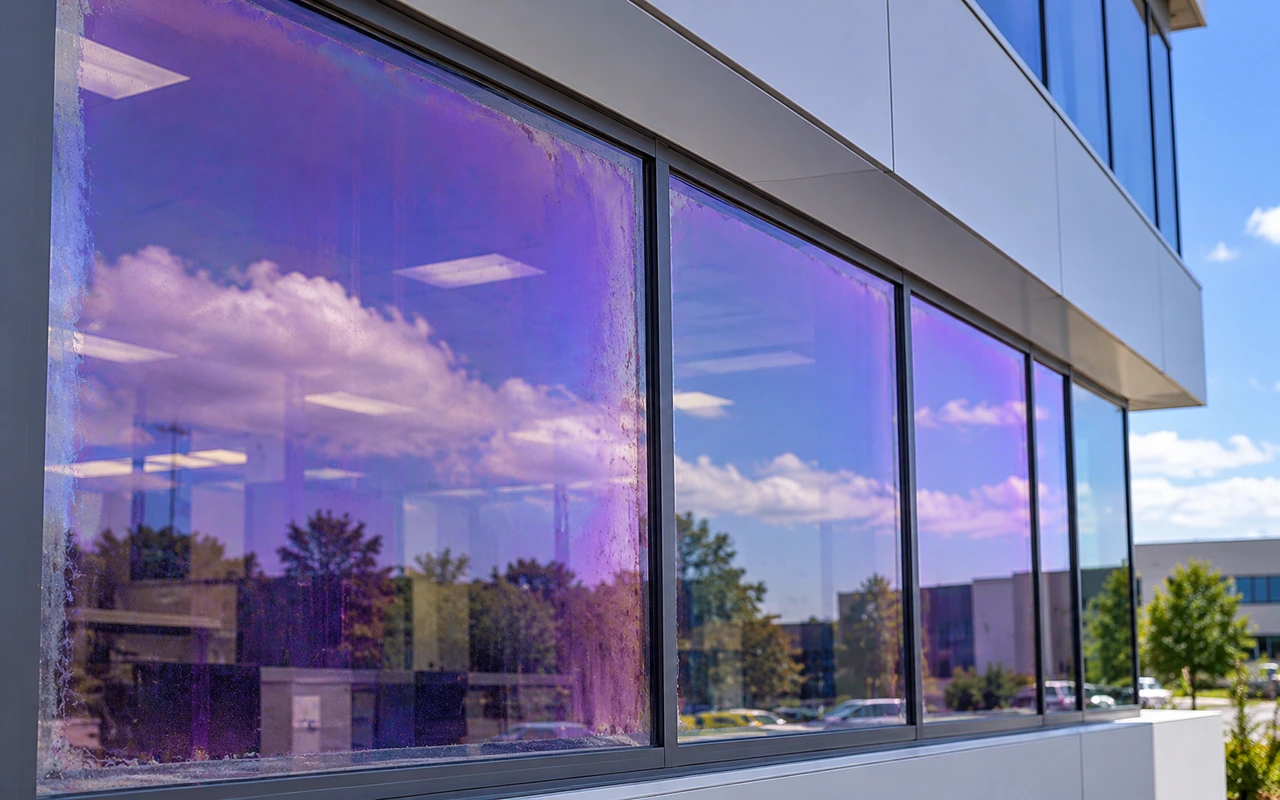
A purple tone in older window film can be a sign that its appearance has changed with age and exposure. It is worth investigating, especially if the colour is uneven or accompanied by peeling or haze. It is not, by itself, a measurement of how much UV or solar protection remains.
Films are manufactured in different ways, so a change in appearance should be assessed against the actual product and its history. Before deciding on removal, check whether the colour is new, whether all panes have the same film, and whether lighting is influencing what you see.
Confirm the change before diagnosing it
Look at the glazing from inside and outside, and compare it under more than one lighting condition.
Reflections, furnishings and neighbouring surfaces can affect apparent colour. A camera’s processing can also exaggerate a purple or blue cast.
If available, compare photographs from shortly after installation. Check whether one pane was replaced or filmed at a different time. A mismatch between products can look like uneven ageing when the panes were never identical.
Gather the original product details if possible. Film lifespan and appearance depend on product construction, exposure and installation conditions; there is no single ageing pattern for every installation.
Understand what colour can tell you
A noticeable colour change may be enough to make a film unsuitable aesthetically, particularly across a group of visible windows. It can justify a condition assessment even if the material remains attached.
It does not establish a precise remaining performance figure. Do not assume that purple film blocks no UV, or that a neutral-looking old film still delivers its original specification. Product information and a proper assessment are more useful than colour alone.
Likewise, a warranty should be read on its actual terms. The existence of a colour change does not automatically establish coverage, and an assumed product age is not a substitute for installation records.
Look for accompanying condition problems
Check for lifting edges, persistent bubbles, cracking or surface damage in the film. Note whether a hazy area appears on the room-side surface or between the panes of a double-glazed unit.
Do not scrape or pull the film to investigate. Record what is visible and ask for an assessment. The general replacement guide helps distinguish ageing material from changes in room requirements or a separate glazing defect.
Where the glass is cracked or the sealed unit has failed, that issue needs attention independently. A different film colour cannot repair it.
Decide whether appearance is the main reason to replace
In a home, a strong cast can change the way an outdoor view or interior colours appear. In a business, mismatched panes may affect the presentation of a reception area or shopfront. Those are legitimate reasons to review the installation, but they should not be confused with proven technical failure.
Describe the desired result: a more neutral view, more daylight, reduced reflection or a consistent appearance across a set of windows. A sample can then be reviewed against that brief.
Do not choose a replacement simply because it is darker and therefore appears to hide the old colour. The old layer and adhesive need proper consideration before new film is applied.
Plan professional removal and surface inspection
Removing established window tint involves more than peeling off a coloured sheet. Old material may release unevenly and adhesive may remain. The glass and any coating influence the appropriate preparation method.
Removal can also reveal pre-existing marks previously obscured by the tint. Discuss the expected finish and the treatment of unexpected defects before approving work. No responsible assessment should promise a perfect underlying surface without checking it.
For several panes, identify the scope clearly. Replacing only the most discoloured pane may leave a mismatch with adjacent ageing film. It may still be the right choice, but review the appearance consequences first.
Select the next film by performance and compatibility
A replacement should address the current room needs as well as appearance. Solar heat, glare, UV exposure and privacy are different considerations. Some products prioritise a lighter look; others reduce more visible light or create more reflection.
Check compatibility with the actual glass, including any double glazing or low-emissivity coating.
Film-to-glass selection should follow the relevant manufacturer’s guidance.
If protecting furnishings is the priority, read the UV and fading guide. UV reduction is useful, but film does not prevent all deterioration from light, heat or the sensitivity of a material.
Keep records for future matching and maintenance
When replacement is completed, retain the product name, installation date, affected panes and care information. That record helps if a pane is replaced later or a new room needs matching film.
Use the cleaning method supplied for the actual film. Do not assume household glass-cleaning tools are suitable for every applied surface. Manufacturer care guidance is more reliable than treating film as bare glass.
The replacement-options guide can help frame the discussion if the room would benefit from something different rather than another version of the original tint.
Frequently asked questions
Does a purple colour prove that film has stopped working?
No. Colour is not a performance measurement. It is a reason to examine the material, its specification and the condition of the installation.
Do all window films turn purple?
No. Film constructions vary. Avoid applying the behaviour of an older product to every modern film.
Can one purple pane be replaced separately?
It may be possible, but a close visual match with neighbouring film is not guaranteed. Review a sample and the condition of the surrounding panes.
Can I clean the purple colour off?
A colour change within the film is not ordinary surface dirt. Do not use aggressive cleaning to try to reverse it. Have the material assessed first.
Discuss the change in your windows
Contact Clear View Tints with whole-window photographs, close-ups and any available installation details. A condition-based recommendation can distinguish an appearance issue from a wider removal or glazing problem.