
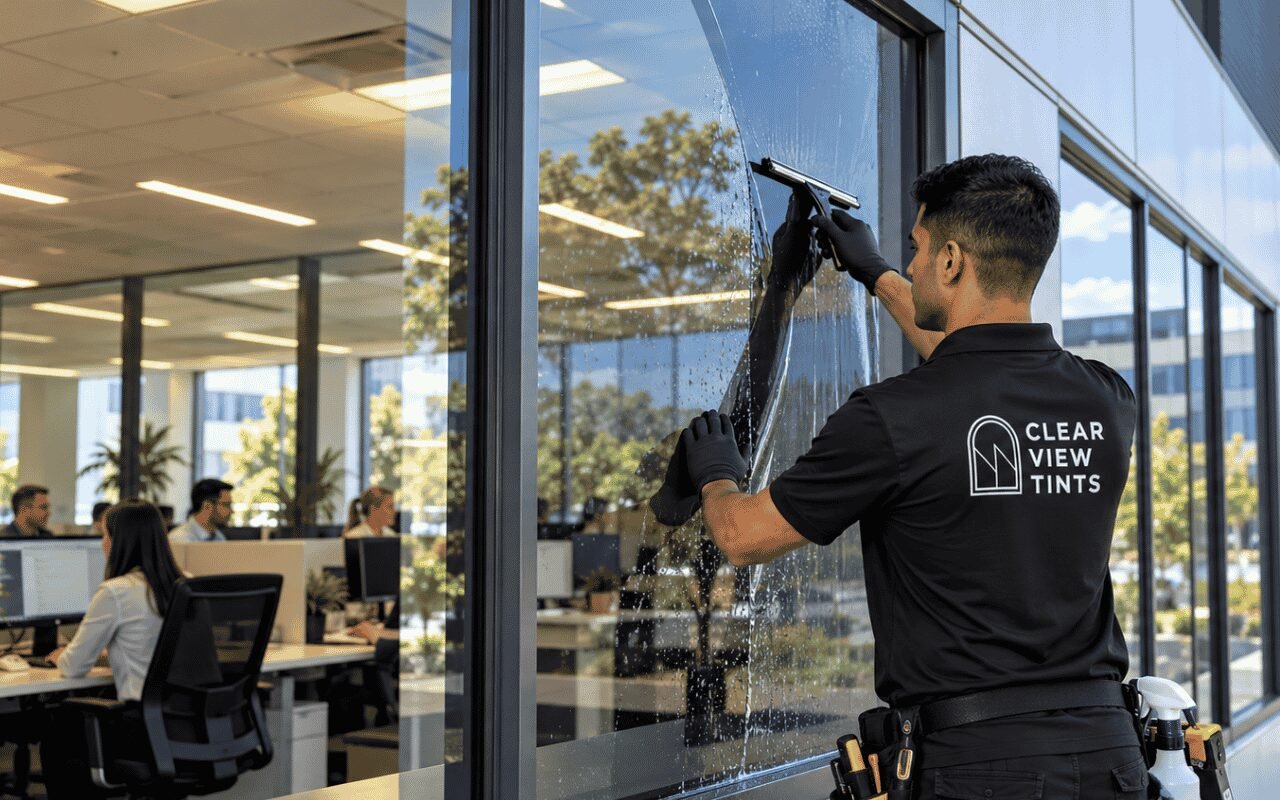
School glazing has several jobs to do. It brings daylight into classrooms, gives staff visibility across circulation spaces and separates offices or support rooms. A solution that works on an exposed classroom window may be wrong for a reception partition or a door that needs clear supervision.
Window film can help with selected heat, glare and privacy problems, but the brief should be written room by room. Glass safety also needs its own assessment rather than being assumed from the appearance of a tint.
Identify the classroom problem precisely
Start with observations from the room. Is sunlight falling directly onto a display? Are students or staff closing blinds because of glare? Is a particular part of the room uncomfortable at a certain time? Record the affected windows, time of day and activities.
Glare and heat are related but different. A dark-looking pane does not tell you whether the room’s solar load, screen reflections or brightness contrast have been addressed. Suitable commercial window film must balance the required control with useful daylight and the characteristics of the glass.
Furniture, screen position and existing blinds should be part of the assessment. Film need not replace all shading. A room used for projected presentations may still need adjustable light control.
Preserve useful visibility and daylight
Consider the room in more than one lighting condition. A sample that looks comfortable in strong sun may feel different on an overcast morning. Review it from the teacher’s position, typical seating areas and outside where the external appearance matters.
Check sightlines through doors and internal windows. Some clear sections may be important for supervision, wayfinding or safe movement. Full coverage should not be selected simply because it gives the strongest visual privacy.
Avoid promising that a film will improve academic results or solve every comfort problem. Its role is to change specific glazing performance; ventilation, heating, shading and building design remain separate factors.
Use privacy film selectively in administration areas
School offices, meeting rooms and student-support spaces may need more visual discretion than a classroom.
Frosted window film can obscure a direct view while transmitting diffuse light, depending on the selected product.
Map what needs screening: paperwork at a counter, a seated conversation or a computer monitor. A partial band may suit one partition while another needs more coverage. Check close-range visibility and silhouettes in the actual lighting.
Visual screening is not acoustic privacy. Frosting cannot stop a conversation being heard through a door or partition. Confidentiality arrangements must address the whole room, not just the appearance of its glass.
Treat safety glazing as a separate question
A solar tint or decorative frost is not automatically a safety-film installation. Where injury from broken glass is the concern, identify the glass type, location, framing and intended performance.
A suitable safety-film system may help retain fragments, but performance depends on the product and installation. It does not make glass unbreakable or automatically establish compliance for every application.
Building managers should check relevant requirements through the appropriate designer, glazing professional or compliance adviser. MBIE’s F2 guidance is a starting point for glass-related injury considerations, not a substitute for a project-specific decision. 4 The commercial safety-film guide explains the questions to raise.
Build a room and pane schedule
For each area, record its name, window measurements, glazing information, existing film and access conditions. Add the required outcome and any visibility that must be retained. A photograph should show the whole opening as well as the problem area.
Prioritise by need rather than applying one film across the campus. A heavily exposed teaching room, an internal office and a covered walkway have different conditions. Product selection should follow the actual glass and use of the space.
Before extending a specification to similar-looking rooms, check whether the glazing is actually the same.
Refurbishments can leave a building with different glass constructions and coatings.
Coordinate work with school operations
Agree access with the person responsible for the premises. Consider visitors, secure areas, cleaning, furniture movement and any work at height. Scheduling during a quieter period may help, but the available programme must be confirmed.
For staged projects, define which rooms are complete, which remain outstanding and how temporary privacy or room restrictions will be managed. The occupied-building installation guide provides a practical framework for discussing disruption.
After installation, provide the cleaning team with the product-specific care instructions. Newly installed film can show temporary drying haze, and cleaners should know which panes need to be left alone during curing.
Keep a maintenance record
Retain the film description, installation date, affected rooms, care guidance and applicable warranty documents. If a pane is later replaced, use those records to request an appropriate match rather than choosing by colour alone.
A useful review after installation asks whether the original problem has improved under comparable conditions. Do not judge a sunny-afternoon glare issue solely from an early-morning inspection.
Frequently asked questions
Can film help with classroom screen glare?
An appropriate film may reduce glare through the affected glazing. Screen position, direct sunlight and room lighting should also be considered when selecting a solution.
Should every classroom receive the same film?
Not automatically. Orientation, glazing construction, shading and room activities may differ. A room-by-room assessment is more useful than a blanket choice.
Can frosting provide privacy for a school office?
It can provide visual screening, depending on coverage and lighting. It does not supply sound insulation or replace other privacy arrangements.
Is a safety film the same as safety glass?
No. A film system and a glazing product are different things. Suitability and compliance must be established for the actual application, not inferred from a product label.
Discuss the priority rooms
Request advice from Clear View Tints with the rooms, glazing photographs and the problems to address. A clear brief helps separate solar control, privacy and safety requirements before a specification is chosen.
Related reading
Technical references
- LLumar: architectural film questions and answers
- LLumar: frosted decorative film
- 3M Safety S80 technical data: application limitations
- MBIE Building Performance: F2 hazardous building materials
- LLumar: architectural film care and maintenance