
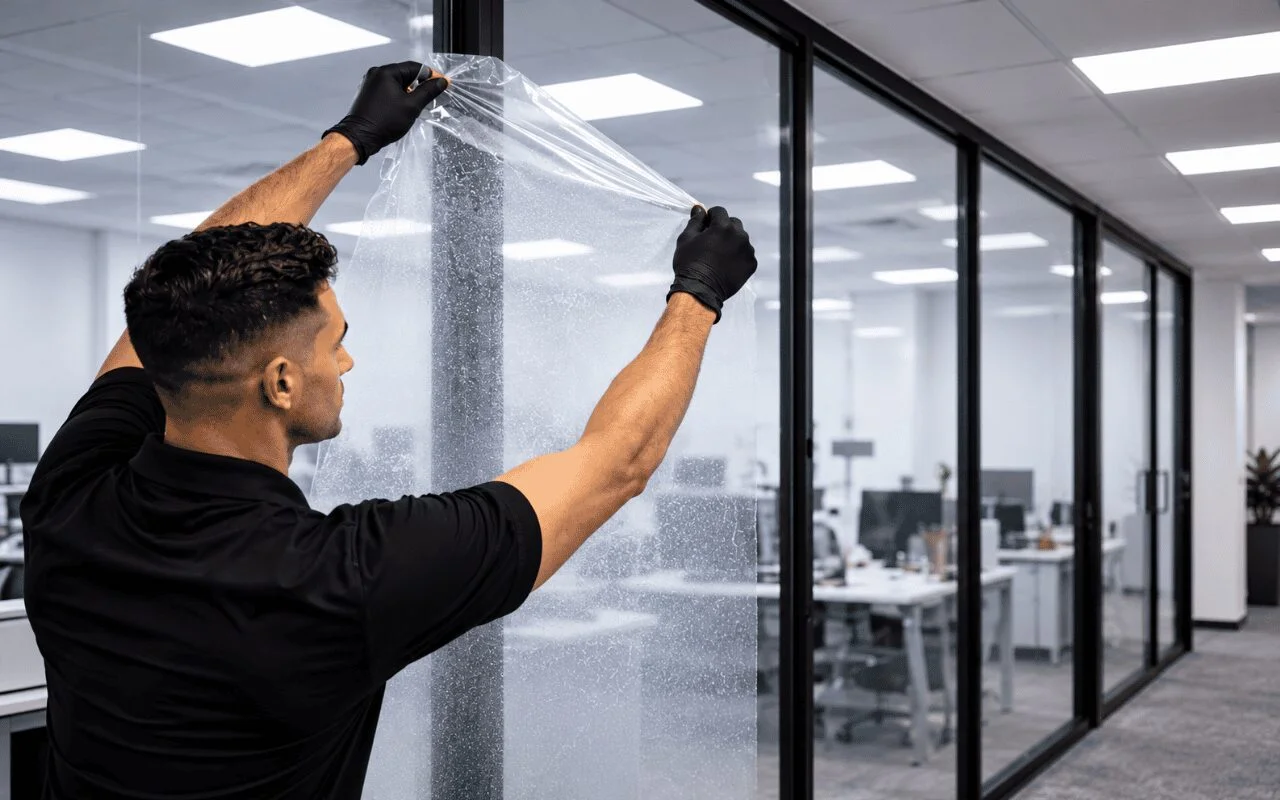
Frosted window film may need replacing because it is damaged, or because the privacy arrangement no longer suits the room. Peeling edges and scratches are one reason to review it. A new desk position, different tenancy or changed bathroom layout can be another.
The best replacement decision considers both the condition of the material and the view you want to control.
Removing old frosting only to reproduce an unsuitable design misses the opportunity to improve how the glass works.
Check the condition of the existing film
Inspect the film for lifting edges, scratches, patchy appearance and areas that have been rubbed or damaged.
Look at the whole pane as well as the visible defect. A small worn patch may be more noticeable when light comes from the other side.
Do not assume every mark is within the film. Surface residue, the underlying glass or an issue inside double glazing can affect appearance. Newly installed film may also show temporary drying effects rather than deterioration. Follow the actual product guidance.
Record what has changed and when. Frosting film removal should be planned around the material and glass condition, not solely around its estimated age.
Test whether the coverage still provides useful privacy
A band that worked for a standing reception area may leave a seated person exposed. A clear logo opening can create an unintended sightline. A bathroom pane that looks private in daylight may need checking with the room illuminated after dark.
Consider viewing distance, inside and outside lighting, and the position of people and objects. Frosted films can obscure detail while transmitting diffuse light, but the selected finish and coverage affect what remains visible.
The privacy-film selection guide can help define the replacement brief. Describe the view that should be screened rather than simply asking for another frosted band.
Decide whether to repair a pane or redesign a group
A damaged pane may be replaceable on its own. First check whether the original product and design can be matched. Ageing, product availability and differences in existing glass can make a perfect visual match difficult.
For a series of office partitions, a coordinated redesign may be worth discussing if the original layout no longer serves the rooms. That is a design choice, not an automatic requirement to replace sound film everywhere.
Confirm the final height, coverage, clear margins and artwork before installation. Keep a drawing or marked photograph so the approved design is unambiguous.
Plan for the temporary loss of privacy
When old frosting is removed, the glass may become clear before the replacement is ready. A consultation room, bathroom or internal office may need temporary screening or to be taken out of use.
Agree the sequence with the person managing the premises. Do not assume a room can remain confidential merely because the removal itself is quick. The guide to removing privacy film from occupied rooms covers practical preparation and access.
Where replacement artwork needs approval, complete that step before removal begins if privacy continuity is important. An unapproved design can delay the useful completion of the room.
Removal includes assessment of the exposed surface
Old frosting can leave adhesive or reveal marks that were not obvious through the diffuse finish. The method must suit the glass and any coating, frames or nearby finishes. Do not assume every surface can be scraped or treated with the same chemical.
A proper scope should describe removal, agreed adhesive preparation and how unexpected defects are handled. It should not promise that every pane will look new underneath.
Do not simply place another film over the old frosting unless a specifically approved product system calls for that application. The new installation needs an appropriate substrate and verified compatibility.
Compare replacement film with other privacy choices
Replacement frosting may be a practical choice where the aim is to retain light and change visual screening. It is not the same as etched glass, and each option has different permanence and maintenance considerations.
The frosting versus etched-glass guide explains those trade-offs. For a home, residential frosting can be assessed around bathrooms and entry glazing. For a business, commercial frosting can be planned around partitions, reception and consultation areas.
Do not assume the fullest coverage is always best. Sightlines, supervision and the intended openness of the room may call for a more specific layout.
Give cleaners the new care instructions
Once replacement film is installed, use the care instructions supplied for that product. Explain any curing period before cleaning and the need to avoid abrasive treatment.
Keep the product name, installation date and approved design. Those details make future matching and maintenance easier than trying to identify a film from a photograph alone.
Frequently asked questions
Can scratched frosting be polished back to new?
Do not use abrasive polishing on film. Have the mark assessed; damaged film may require replacement rather than aggressive cleaning.
Can the replacement use a different design?
Yes, where suitable. Confirm coverage, sightlines and artwork before installation rather than automatically copying an outdated layout.
Does frosting make a room soundproof?
No. It changes visual screening, not the acoustic performance of the partition. Other privacy measures may still be needed.
Can one pane be replaced without changing the others?
Sometimes. Check product availability and appearance matching before assuming the repaired pane will be indistinguishable.
Review the old film and the new privacy need
Request a frosting-removal assessment from Clear View Tints. Send photographs of the current condition and explain the view you need to control so removal and replacement can be considered together.
Technical references
- LLumar: architectural film care and maintenance
- LLumar: frosted decorative film
- Avery Dennison: architectural film installation and maintenance, February 2026