
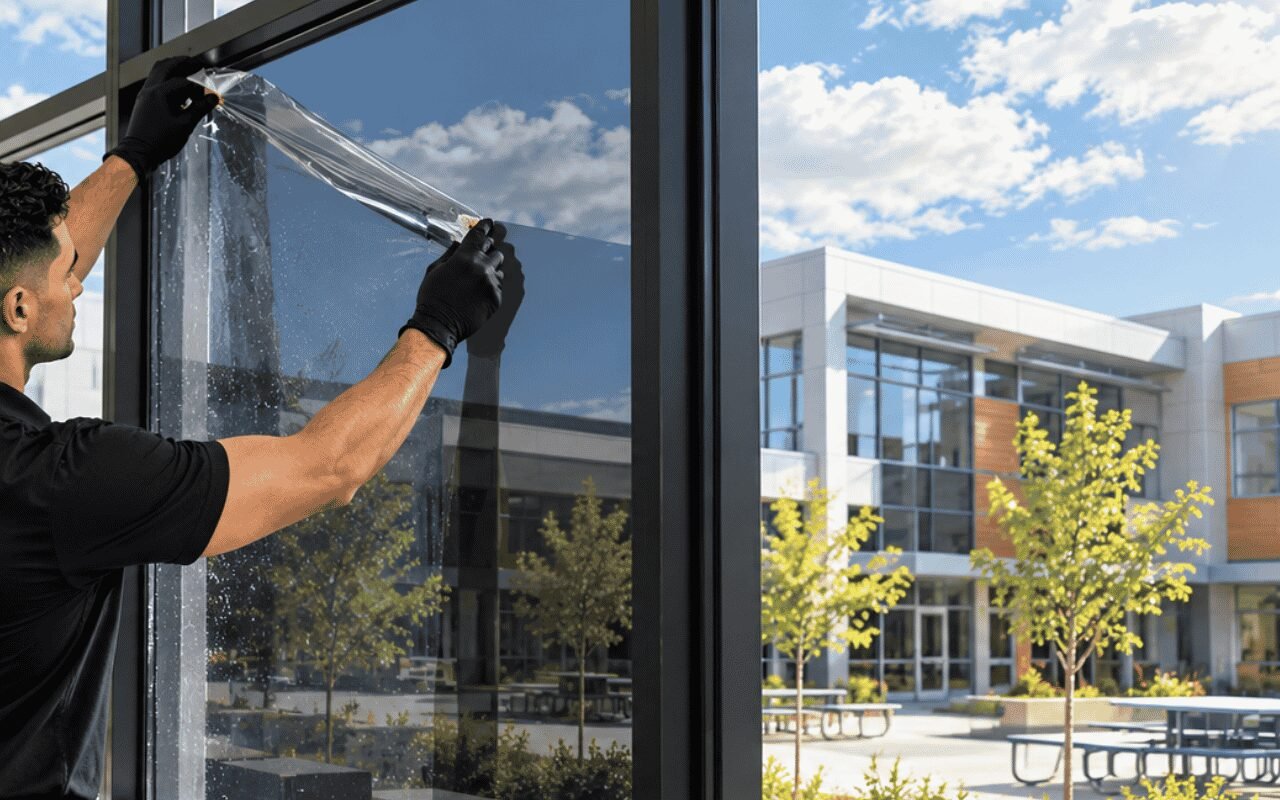
Choosing a commercial window film starts with deciding what it must do. Reducing heat, obscuring a view and helping retain broken glass are different functions. The word “tint” is often used loosely, but it does not describe the performance of every film.
For an Auckland business, a useful specification connects the room’s problem to a suitable product and glazing system. It also makes the trade-offs clear: daylight, reflection, views, privacy, access and the appearance of the building.
Solar-control film: heat, glare and daylight
Solar-control window film is used to change how glazing handles sunlight. Products vary in solar performance, visible light transmission and reflectivity. Some prioritise a lighter appearance; others provide stronger visible-light reduction.
Identify whether the main complaint is heat, direct sun, screen glare or fading exposure. Those concerns can overlap, but a product should not be selected by shade alone. Ask for the relevant technical information on the intended glass, then consider how it will affect the occupied room.
A lighter appearance may be important for a shop display, while a screen-heavy workspace may need a different balance. Existing blinds can remain useful for variable sunlight and night-time privacy.
Privacy film: decide which view should change
Privacy can mean preventing a direct view into a consultation room, screening a desk from a corridor or reducing daytime views into a building. These are not all solved by the same film.
Frosted decorative film can obscure detail while allowing diffuse light through. Coverage and lighting determine what remains visible; silhouettes or movement may still be apparent.
Reflective solar film is different. Its privacy effect depends on the relative brightness on either side of the glass. When the interior is brighter at night, the result may not meet the same privacy expectation. Check evening conditions instead of relying on a daytime demonstration.
The privacy-film selection guide considers bathrooms, offices and entry glazing in more detail.
Safety and security film: ask about the complete system
Safety and security film is specified for particular glass-related risks. Depending on the product and installation, it may help hold fragments together after breakage or form part of a tested system. It does not make a window unbreakable.
Thickness or a tinted appearance is not enough to establish performance. The glass, frame, film and any required attachment system matter. Manufacturer limitations must be read alongside test information and the actual application.
Do not assume a decorative frost is a safety product, or that every safety film provides the solar performance required by the room. Where compliance or security is material, have the proposed system assessed by the appropriate qualified people.
Compare functions before comparing brands
A simple selection brief answers four questions: what problem needs solving, what glass is present, what appearance is acceptable, and what evidence is needed for the proposed performance.
For solar control, discuss heat, visible light and reflection. For privacy, discuss sightlines and lighting on both sides. For safety, discuss the specific risk and verified system requirements. The same comparison method is more useful than asking for the “strongest” or “best” film without context.
Multiple film types may be appropriate within one premises. External office windows, internal meeting rooms and exposed doors do not have to receive one universal product.
Confirm compatibility with the glass
Glass can be single or double glazed, tinted, coated, laminated or otherwise specified. Existing film, edge condition and shading can also matter. Compatibility should be checked using the selected manufacturer’s guidance rather than appearance alone.
Do not assume that a film suitable for one clear pane is suitable for every insulated or low-emissivity glazing unit in the building. If glass identification is uncertain, record that uncertainty and resolve it before installation.
Cracked glass, failed sealed units and other glazing defects may need separate attention. Film is not a repair for those conditions.
Review a sample in the working environment
Look at a sample from the positions that matter: a desk, meeting table, shop aisle or reception seat. Check daylight, artificial lighting and views from outside. For a privacy film, test the relevant viewing distances and both standing and seated positions.
Agree colour, coverage, border treatment and any decorative layout before ordering. A large glazed facade can make slight differences between panes conspicuous, so include existing film and later replacement considerations in the discussion.
Photographs help record the proposal but are not a complete substitute for viewing the actual sample.
Camera exposure and screens can alter how light and reflection appear.
Keep product choice separate from project scope
Once the film category is clear, confirm preparation, old-film removal, access, scheduling and care. A quote should identify what is being installed and where, not simply list “window tint” without a specification.
For customers still deciding whether they need tinting, frosting or removal, the business service-selection guide provides the next step. Pricing considerations belong in the Auckland window tinting cost guide.
Frequently asked questions
Can one film provide solar control and privacy?
Some products combine functions, but the result depends on the film and lighting conditions. Confirm the specific performance rather than assuming every tint gives suitable privacy.
Is the darkest film always best for heat?
No. Appearance alone is not a reliable specification. Compare the product’s relevant performance data and suitability for the glass.
Does clear safety film also solve glare?
Not necessarily. Safety and solar-control performance are separate requirements. Ask whether the specified product addresses both.
Can different rooms have different films?
Yes, where suitable. A coordinated design can use different products for external solar control and internal visual privacy without pretending the needs are identical.
Build a clear film-selection brief
Contact Clear View Tints with the main problem, glass details and preferred appearance. The starting point should be a suitable solution for the premises, not a product chosen only by its shade or marketing name.
Related reading
Technical references
- LLumar: architectural film questions and answers
- LLumar: frosted decorative film
- LLumar: reflective and dual-reflective films
- 3M Safety S80 technical data: application limitations
- International Window Film Association: glass compatibility, fading and lifespan